by Ubiratan D’Ambrosio
It is important to clarify, from this very beginning, about my career and how I arrived to Mathematics Education. I was born in 1932. In 1949 I was already giving private tutoring classes for people preparing to enter public service (mainly tutoring Financial Mathematics). I graduated 1954, with a major in Mathematics (Pure) and taught, for some years, in high-schools. In 1958 I was hired as a full time instructor and graduate student at the University of São Paulo (USP) and received my Doctorate in 1963, with a thesis on Calculus of Variations and Measure Theory (very pure!). In 1964, I went to the USA as a Research Associate at Brown on a year leave, but due to the political events in Brazil, I stayed there and became a tenured faculty at the State University of New York at Buffalo. My first PhD student wrote his thesis on Stability of Differential Equations. During this time, my interest in Education was occasional and minimal. In 1972, I returned to Brazil and became the Director of the Institute of Mathematics, Statistics and Computer Science of the State University of Campinas (UNICAMP), which grew as a major research institution. My first Brazilian doctoral student in Campinas wrote a thesis on Measure Theory and Minimal Surfaces. From this period I realized that Mathematics Education was priority for Brazil, mainly motivated by the cultural and social barriers which were so responsible for failing and dropping out of children coming form marginalized groups. They could not compete with children coming from families with some scholarity. At the same time, I developed an interest in History of Mathematics and on broad (trancultural and transdisciplinarian) theories of knowledge. This is my background.
My current concerns about research and practice in math education fit into my broad interest in the human condition as related to the history of natural evolution (from the Cosmos to the future of the human species) and to the history of ideas. Particularly, the history of explanations of the creation and the natural evolution.
In the last years (surely much before the last five), my motivation has been the pursuit of peace (in all four dimensions: individual, social, environmental and military). I attribute the violations of peace, in all these four dimensions, to the mistaken course of the Western civilization. I try to understand the founding myths of Western civilization, and this links to my research on the history of monotheistic religions (Judaism, Christianity, Islamism), of techniques, of arts and how mathematics permeates all this. A great support is gained by looking into non-Western civilizations. I base my research on established forms of knowledge (communications, languages, religions, arts, techniques, sciences, mathematics) and in a theory of knowledge and behaviour which I call the "cycle of knowledge". This theoretical approach recognizes the cultural dynamics of the encounters, based on what I call the "basin metaphor". All this links to the historical and epistemological dimensions of the Program Ethnomathematics, which can bring new light into our understanding of how mathematical ideas are generated and how they evolved through the history of mankind. It is fundamental to recognize the contributions of other cultures and the importance of the dynamics of cultural encounters. Culture is understood in its widest form, and includes art, history, languages, literature, medicine, music, philosophy, religion and science. Research in ethnomathematics is necessarily transcultural and transdisciplinarian. The encounters are examined in its widest form, to permit exploration of more indirect interactions and influences, and to permit examination of subjects on a comparative basis. Although academic mathematics developed in the Mediterranean basin, expanded to Northern Europe and later to other parts of the World, it is difficult to deny that the codes and techniques to express and communicate the reflections on space, time, classifying, comparing, which are is proper to the human species, are contextual. Among these codes are measuring, quantifying, inferring and the emergence of abstract thinking.
At this moment, it is important to clarify that my view of ethnomathematics should not be confused with ethnic-mathematics, as it is understood by many. This is the reason why I insist in using Program Ethnomathematics. This program tries to explain mathematics, as it tries to explain religion, culinary, dressing, football and several other practical and abstract manifestations of the human species. Of course, the Program Ethnomathematics was initially inspired by recognizing ideas and ways of doing that reminds us of Western mathematics. What we call mathematics in the academia is a Western construct. Although dealing with space, time, classifying, comparing, which are is proper to the human species, the codes and techniques to express and communicate the reflections on these behaviors is undeniably contextual. I got an insight into this general approach while visiting other cultural environments, during my work in Africa, in practically all the countries of continental America and the Caribbean, and in some European environments. Later, I tried to understand the situation in Asia and Oceania, although with no field work. Thus came my approach to Cultural Anthropology (curiously, my first book on Ethnomathematics was placed by the publishers in a collection of Anthropology).
To express these ideas, which I call a research program (maybe inspired by Lakatos?), I created a neologism, ethno-mathema-tics. This caused much criticism, because does not reflect the etymology of "mathematics". Indeed, the mathema root in the word ethnomathematics has little to do with "mathematics" (which is a neologism introduced in the XIV century). The idea of organizing these reflections occurred to me while attending ICM 78, in Helsinki. I played with Finnish dictionaries and was tempted to write alustapasivistykselitys for the research program. Bizarre! I believed Ethnomathematics would be more palatable.
I understand that there are immediate questions facing World societies and education, particularly mathematics education. As a mathematics educator, I address these questions, thus my links to the study of curriculum, and my proposal for a modern trivium: literacy, matheracy and technoracy. This is one of main lines of work in mathematics education.
The pursuit of Peace (in all four dimensions mentioned above), is an urgent need. This explain my works in Mathematics and Peace, Mathematics and Ethics, Mathematics and Citizenship. This is the theme of several lectures and courses for in-service teachers. I have published studies on curriculum and oriented several doctoral theses with this focus.
These two lines of my current work in mathematics education link, naturally, to the pedagogical and social dimensions of the Program Ethnomathematics.
It is important to insist that the Program Ethnomathematics is not ethnic mathematics, as some commentators interpret it. Of course, I work with different cultural environments and work, as an ethnographer, trying to describe mathematical ideas and practices of other cultures. This is a style of doing ethnomathematics, which is absolutely necessary. But these cultural environments include indigenous populations, labour and artisan groups, periphery communities in urban environment, farms, professional groups. They develop their own practices, have specific jargons and theorize on their ideas. This is an important element for the development of the Program Ethnomathematics, as important as the cycle of knowledge and the recognition of the cultural encounters.
More recently, I have worked with the preparation of teachers for indigenous communities in the State of São Paulo. Altogether, there are about 100 small tribes (some with different languages), totalising about only 8,000 individuals. We are now starting a project on the ethnomathematics of the "quilombolas", which are small communities originated from slaves who fled in the XVII and XVIII centuries, and established themselves as small republics in the hinterland of Brazil. The research resulting from all these projects feeds the Program Ethnomathematics.
Besides these more immediate concerns, there are long term concerns. Of course, they are related. Thus my links with Future Studies. I have been active, publishing and lecturing, on history and philosophy focusing future.
I see the special role of technology in the human species and the implications of this for science and mathematics. Thus I focus history of science (and, of course, of mathematics) trying to understand the role of technology as a consequence of science, but also as an essential element for furthering scientific ideas and theories. Basically, I guide much of my investigation on three basic questions:.
How are ad hoc practices and solution of problems developed into methods?
How are methods developed into theories?
How are theories developed into scientific invention?
Once recognized the role of technology in the development of mathematics, reflections about the future of mathematics propose important questions about the role of technology in mathematics education. Hence, my line of work in distance education.
Reflections about the presence of technology in modern civilization leads, naturally, to question about the future of our species. My growing interest in the emerging fields of Primatology and Artificial Intelligence, lead to a reflection about the future of the human species. Cybernetics and human consciousness lead, naturally, to reflections about fyborgs (a kind of "new" species, i.e., humans with enormous inbuilt technological dependence). Our children will be fyborgs when, around 2025, they become decision makers and take charge of all societal affairs. Educating these future fyborgs calls, necessarily, for much broader concepts of learning and teaching. The role of mathematics in the future is undeniable. But what kind of mathematics? Once again, I look for explanations in history.
To understand how, historically, societies absorb innovation, is greatly aided by my involvement with world fiction literature (from iconography to written fiction, music and cinema). I feel it is important to understand the way material and intellectual innovation permeates the thinking and the myths, and the ways of knowing and doing of non-initiated people. In a sense, how new ideas vulgarise, understanding vulgarise as making abstruse theories and artifacts easier to understand in a popular way. This places me on the side of "post-modernists" in the current science wars.
Although this is a difficult position to defend in academics, particularly as a math educator and historian, this summarizes my involvement with current philosophy.
How communities deal with space and time, mainly the sacralization of chronology and topology in history, is central in my thinking. A recent doctoral student of mine worked on concepts of space and time in a modern popular urbanization in the Amazon basin. Another doctoral student deals on how the concept of space permeates the medieval emergence of non-euclidean geometry. And another student looks into modern art and mathematics.
I am now working on a paper dealing with the relations of ethnomathematics, ethnomethodology and phenomenology. I look into their evolution and try to identify a common underlying philosophical framework, through a transcultural and transdisciplinarian lecture.
Let me comment, now, how does these ideas relate to mathematics education, particularly in Brazil, where the situation does not differ much of many other countries which have an intense population dynamics, as for example the USA. These are countries were much progress is noticed. Never in Brazil the publishing houses flourished so much, and never the industrial and agricultural production was so intense. This contradicts official assertion, based on the results of tests and national exams, that the school system is a great failure. According to official sources, Brazil is in a terrible shape in reading, writing and mathematics. Any system, with such results, would have been declared irremediably bankrupt.
I am much worried with the cultural dynamics of the encounter of generations (parents and teachers and youth). This encounter is dominated by mistrust and cooptation, reflected in testing and evaluation practices, which dominate our civilization. In mathematics education, this is particularly disastrous. Paradoxically, the voices of individual math educators are against this, but the practice of the totality insists in sameness. The result is teaching mathematics in an uninteresting, obsolete and useless way.
Resources to testing is the main argument to justify current math curricula. The claims of importance of current math curricula are fragile. Myths surround these claims. These have been, since the 60s, my main motivation for my thoughts about math education. In the last years, this has been intensified by my analysis of results of testing in Brazil and elsewhere in the World.
I try to understand children and youth behaviour and their expectations. History gives us hints on how periods of great changes affect the relations between generations. Most interesting is the analysis of movements after WWII and Viet Nam War.
Synthesizing, there is more concern with mathematics than with our children. In general, education is dominated by a kind of "corporatist" expectations for the future [this is why education leads to the reemergence of fundamentalism and fascism] and, regrettably, mathematics and mathematics education have everything to do with this. Test may be the best instruments to allow this.
I believe that the work done by me and by my colleagues had, or is going to have even more, an actual impact on the practice of mathematics education. The research done by all of us, have a high academic level, leading to different approaches to math education and touch important social issues. But it is a slow process, with many reactions.
I learned from a colleague Science Educator in the early 70s, that changes in education occur by "stealth". I have confirmation of this. When I visit schools, invited by colleagues and former students, and I have an opportunity to talk with students, I see how effective is the "stealth approach".
Although unwritten, unreported, unnoticed by the political and academic authorities, the innovation benefit enormously some students, while other students not even notice this, and prepare for testing. What is wrong with testing? Basically, because they penalize the former, which are creative, and favour the later, which are cooptable and amenable to sameness. Although homogeneous behavior and results are unnatural in the human species, this is the supporting argument for stardardized testing, which prevails in evaluation, although it is denied by the theoreticians who support current testing.
Monday, February 23, 2009
Ethnomathematics: My Personal View

Tuesday, January 27, 2009
Tak Tepermanai
Ada dua infiniti, atau dalam istilah yang lain, tak tepermanai. Satu, adalah infiniti nyata (actual infinity), dan satu lagi adalah infiniti keupayaan (potential infinity).
Ahli matematik percaya, setiap hitungan adalah merujuk kepada infiniti keupayaan, bukannya infiniti nyata. Begitu juga fizik, yang merupakan sahabat karib matematik. Dalam fizik ini, semua infiniti turut dianggap sebagai keupayaan, bukannya nyata.
Walau bagaimanapun, fizik itu juga ada aspek cerapan (ujikaji), selain aspek matematiknya (teori). Soalnya, adakah wujud sebarang cerapan yang memang benar-benar infiniti?
Friday, March 16, 2007
Tentang Myelin
 Terdapat dua jenis myelin. Pertama, myelin yang wujud secara tabii dalam sistem biologi manusia. Myelin yang mengadungi pelbagai protein dan lipid ini terdapat pada bahagian saraf otak manusia. Di samping itu, myelin ini turut terdiri daripada membran multilamelar menerusi beberapa dwilapisan yang membaluti saraf akson, selain menjadi asas kepada pengaliran isyarat.
Namun, terdapat satu lagi jenis myelin. Menerusi pencerapan di bawah mikroskop optik, myelin daripada jenis hablur cecair ini terhasil ekoran kehadiran surfaktan. Manakala dalam gambar di atas merupakan rakaman myelin yang dicerap menerusi lamellar daripada sistem sukrosa ester (1570)-dekanol-air.
Tetapi, apa faedahnya penyelidikan tentang myelin ini? Dan, mengapakah tidak semua lamellar dapat menghasilkan myelin?
Friday, February 16, 2007
Kontroversi Einstein (1)
Pendahuluan
Tahun 2005 sebelum ini, kalangan komuniti sains baru saja meraikan Annus Mirabilis bersempena pencapaian menakjubkan Albert Einstein (1879-1955) pada sekurun yang lalu. Serentak pada tahun yang turut digelar wunderjahr tersebut, terdapat empat makalah Einstein yang termuat dalam Annalen der Physik dicanangkan sebagai memberikan dampak revolusioner terhadap perkembangan fizik moden. Ini termasuklah makalah mengenai (1) kesan fotoelektrik, (2) gerakan Brownian, (3) teori kenisbian khas, dan (4) kesetaraan antara jirim dan tenaga.
Bahkan, lebih jauh lagi, salah satu daripada makalahnya tersebut, iaitu tentang kesan fotoelektrik, kemudiannya telah mengiring Einstein ke pentas penganugerahan Nobel pada tahun 1921. Walau bagaimanapun, ironinya penemuan mashyur Einstein tentang Teori Kenisbian Khasnya mahupun Teori Kenisbian Amnya (pada tahun 1915, hasil ubah-suai dari teori yang sebelumnya), sering saja gagal menarik persetujuan serta kesepakatan kalangan jawantankuasa penganugerahan Nobel, meskipun ia kerapkali dicalonkan.
(Dikatakan, salah satu faktor yang menghalang penganugerahan Nobel tersebut ekoran majoriti ahli jawatankuasa pemilihan mahu mengelakkan diri mereka dari perdebatan terhadap kesahan teori tersebut. Meskipun begitu, anugerah Nobel untuk Einstein dirakamkan sebagai menghargai peranannya dalam menerangkan kesan fotoelektrik serta sumbangannya dalam bidang fizik teori).
Berbeza dengan Einstein dalam padanan budaya popular—yang sering dijajai serta disimbolkan—sebagai kemuncak kepada kepintaran manusia, sebaliknya catatan bersiri ini berusaha untuk menyelak beberapa sisi yang kurang diketahui, atau kurang enak didengar mengenai liku-liku akademik Einstein. Manakala, istilah kontroversi Einstein dipilih supaya tampak lebih adil dan tidak kelihatan berat sebelah berbanding dengan istilah mitos, meskipun kecenderungan tersebut tidak dapat dinafikan dengan mudah.
Sementara itu, intipati dan sentuhan tema kepada catatan bersiri ini dijangka akan menyingkap mengenai pengaruh ujikaji-ujikaji tertentu serta hasil-hasil penemuan terdahulu, maksudnya sebelum tahun ajaibnya Einstein itu lagi. Dan, menerusi singkapan ini, kita akan dipaparkan bagaimana ujikaji-ujikaji tersebut serta hasil-hasil penemuan oleh para ilmuan sebelumnya, dikatakan turut mempunyai beberapa persamaan dengan apa yang telah didakwa kepada kita sebagai suatu penemuan asli Einstein semata-mata.
Di samping itu juga, kita turut akan meneliti pengaruh serta propaganda mereka yang berada di sekitar Einstein, yang mana mereka ini disebut-sebut ada membantu Einstein sewaktu merumuskan makalah-makalahnya revolusionernya tersebut, selain mewar-warkan kecemerlangan penemuan hebatnya itu. Lantaran itu, catatan bersiri ini pastinya tidak dapat mengelak dari bakal menyentuh beberapa perkara yang pernah dianggap tabu tentang coretan sebenar kisah Einstein.
Walau bagaimanapun—yang lebih penting dari itu semua paparan tersebut—tujuan murni usaha ini adalah untuk mengkritik secebis pembinaan tamadun ilmu Barat, sembari membelek analisa sejarah serta tawaran struktur pengetahuan yang lebih bernas dari yang sebelumnya. Mungkin struktur pengetahuan alternatif ini bukan sahaja dapat digali dari tamadun ilmu Barat sendiri, tetapi juga boleh diteroka menerusi tradisi serta khazanah pengetahuan yang terhimpun dalam belahan dunia Islam.
Tuesday, September 12, 2006
Semesta
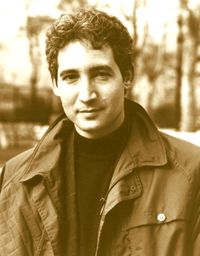 Barangkali ramai yang lebih berahi menonton berbanding dengan membaca. Apatah lagi, sekiranya bahan bacaan tersebut di luar persekitaran pendidikannya. Brian Greene, seorang professor dalam teori fizik tetali dari Columbia University pernah menulis buku, The Elegant Universe: Superstrings, Hidden Dimensions, and the Quest for the Ultimate Theory (1999). Meskipun buku tersebut berkategori popular, namun maseh membentangkan cabaran untuk menghadamnya. Sebab itu, saya begitu mashyuk bila bertemu dengan versi dokumentarinya. Nyata sekali, dokumentari ini telah membaur rasa gembira serta membuak rasa ghairah terhadap keasyikan fizik moden. Untuk sama-sama berkongsi perasaan tersebut, silalah semak jaringan yang dilampirkan di bawah, yang mana ketiga-tiga siri dokumentari ini dimainkan sekitar satu jam setiap satunya, tidak lebih!
+ The Elegant Universe: Einstein's Dream (siri 1)
+ The Elegant Universe: String's the Thing (siri 2)
+ The Elegant Universe: Welcome to the 11th dimension (siri 3)
Selamat menonton!
Friday, September 1, 2006
Keanehan Grisha
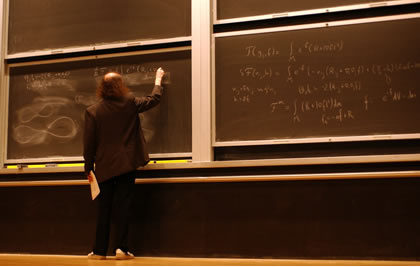 Menolak Fields Medal 2006, enggan menerima anugerah dari European Mathematical Society dan kemudiannya sinis dengan hadiah US1 Juta dari Clay Mathematics Institute di Boston. Beliau juga tidak melayan permintaan temubual media serta langsung tidak berminat dengan jurnal-jurnal akademik. Semua pendirian ini adalah karekteristik Grigory ‘Grisha’ Perelman, seorang matematikawan misteri dari Steklov Institute of Mathematics, Russia. Malah, beliau menuduh para juri yang menilai hasil kerjanya tidak cukup layak, manakala komuniti matematikawan pula dianggapnya sebagai hipokrit serta hidup penuh dengan ketidakjujuran.
Grisha – yang pernah memenangi International Mathematical Olympiad dengan catatan markah sempurna ketika berusia 16 tahun – sebenarnya cuba untuk lari dari kelaziman sambil melihat persoalan-persoalan di sekelilingnya dari dimensi yang berbeza. Sebab itu beliau cuba menyindir komuniti matematikawan konvensional dengan menyatakan bahawa bahawa sebarang hasil kerjanya tidak pernah dibiayai oleh mana-mana dana sekalipun. Ia adalah dari tabungannya sendiri. Tidak hairan, Professor Marcus du Sautoy dari Oxford University cuba memahaminya dengan berkata, “Perelman sebenarnya tidak berminat dengan wang. Baginya, anugerah terbesar ialah berjaya membuktikan teoremnya”.
Dan, Grisha namanya tiba-tiba mashyur bilanya diumumkan sebagai antara pemenang Fields Medal 2006 – anugerah yang dianggap sekelas dengan Nobel. Ini kerana hadiah Nobel yang berprestij itu tidak diberikan kepada bidang matematik. Tiga kertasnya yang menarik itu mula disiarkan dalam Arxiv [(1) Finite extinction time for the solutions to the Ricci flow on certain three-manifolds, (2) Ricci flow with surgery on three-manifolds, (3) The entropy formula for the Ricci flow and its geometric applications] semenjak November 2002 lagi. Dan, kini ia terpaksa ditutup kerana ribuan orang ingin membacanya serentak. Dalam kertas tersebut, Grisha membuat sumbangan penting ke atas geometri Riemann serta topologi geometrik.
Secara khususnya lagi, Grisha telah berjaya membuktikan konjektur geometri Thurston yang melibatkan struktur geometrik pada persoalan matematik yang lebih dikenali sebagai manifold. Dan, pembuktiannya ini sebenarnya merupakan penyelesaian ke atas konjektur Poincaré. Justeru, ekoran konjektur Poincaré ini merupakan persoalan khusus yang terdapat dalam konjektur Thurston, maka ini sekaligus bermakna Grisha juga telah berjaya membuktikan kebenaran konjektur Poincaré, yang selama seabad terakhir ini dianggap sebagai masalah matematik yang paling sukar.
Malangnya, sumbangan Grisha ini barangkali adalah hasil kerja matematik terakhirnya yang dapat kita saksikan. Grisha, yang hanya baru berusia 40 tahun, kini dikhabarkan sudah bersara dan enggan dikenali sebagai seorang matematikawan lagi. Tinggal bersama ibunya di St. Petersburg, Grisha hanya hidup atas wang pencen ibunya. Malah, beliau cukup tidak senang dengan tindakan Asian Journal of Mathematics pada Jun 2006 yang menyiarkan kertas kerja Xi-Ping Zhu (dari Sun Yat-sen University, China) & Huai-Dong Cao (dari Lehigh University, Pennsylvania). Kertas tersebut “A Complete Proof of the Poincaré and Geometrization Conjectures - application of the Hamilton-Perelman theory of the Ricci flow” merumuskan hasil Grisha secara lengkap dan akademik mengenai pembuktian konjektur Poincaré.
Sebenarnya, keunikan pendirian Grisha ini bukanlah suatu kejanggalan dalam dunia akademia. Sekiranya Richard Feynman tidak menolak hadiah Nobel 1965 atas sumbangan elektrodinamik kuantum bersama Julian Schwinger dan Shin-Ichiro Tomonaga, tentunya Feynman juga seperti Grisha. Kerana, selain hadiah Nobel, Feynman sebelum itu sudah pun menolak sejumlah besar pengiktirafan yang diberikan kepadanya. Malah, fikiran Feynman tidak kurang gilanya. Bahkan tidak mustahil, kita mungkin juga akan saksikan nanti seorang Felo Akademi Sains Malaysia yang akan memulangkan semula anugerah felo tersebut. Beliau, yang memang tidak melihat peranan signifikan Akademi tersebut, khabarnya hanya menunggu saat yang sesuai untuk berbuat demikian.
Begitu juga dengan sikap ‘tidak betul’ Grisha. Ia juga bukanlah suatu keanehan. Pernah diceritakan, seorang mantan professor fizik teori dari UKM, hanya tahu menggunakan keretanya semata-mata, tetapi tidak pernah ambil peduli soal minyak pelincir (dan maintenance) kereta tersebut. Dan, kereta tersebut terus-menerus digunakannya sampailah rosak dengan sendirinya. Kalau tidak membeli kereta baru, tentunya ribuan ringgit sudah terbuang untuk memperbaiki kereta tersebut. Lebih lucu lagi, kalau anda pernah dengar kesah telatah sosial seorang professor fizik optik dari UM, yang dipercayai boleh bikin hairan dan ketawa yang tak sudah-sudah dari kita.
Memang, alam saintis itu kadangkala indah dan mengasyikkan. Namun, usahlah dihairankan jika anda bertemu dengan saintis yang berperangai seperti ini, lantaran Grisha bukanlah satu-satunya saintis yang pernah berperangai demikian. Dan, barangkali menonton filem A Beautiful Mind (2001) boleh membantu kita memahami 'spesies' Grisha dengan lebih baik lagi.
Wednesday, August 30, 2006
Pluto Tersingkir
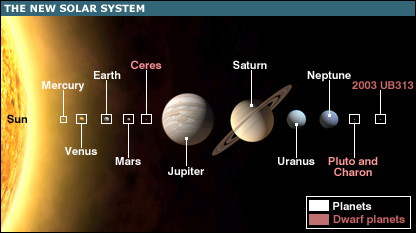 Untuk diiktiraf sebagai sesebuah planet, maka sesuatu objek itu disyaratkan (1) mengorbit Matahari, (2) berukuran cukup besar sehingga mampu mempertahankan bentuk sferanya, dan (3) memiliki jalur orbit yang jelas dan bersih (dengan maksud, tidak ada benda samawi lain di orbitnya).
Dengan definisi baru ini, Pluto kini sudah dilucutkan tarafnya oleh International Astronomical Union (IAU) pada 25 Ogos 2006 yang ketika itu bersidang di Republik Czech. Sekarang Pluto hanya dikenali sebagai sebuah planet kerdil sahaja --> bersama-sama dengan Charon, Ceres dll.
Sains, seperti definisi popular, itukan berupa analisis fenomenon secara sistematik, mantik dan objektif dengan kaedah khusus yang diperantikan bagi mewujudkan penumpukan pengetahuan yang boleh dipercayai. Dan, dengan dukungan definisi ini, maka sudah tentu sains itu boleh berubah, malah boleh juga bercanggah dengan perspektif sebelumnya.
Jadi, tidak ada apa yang perlu kita gusarkan tentang perubahan bilangan planet di tatasuria kita ini. Selagimana bumi kita masih lagi mengorbit matahari dalam keadaan lazim, kita hakikatnya masih 'aman'. Melainkan, anda mempunyai kepercayaan kental bahawa angka sembilan adalah lambang kesempurnaan, maka memang wajar sekali anda perlu merasa gusar!
Thursday, August 10, 2006
Fizik
[Kiriman ini khas untuk mahasiswa fizik, yang ada antaranya sudah lemah semangat dan kelihatan seperti terpaksa untuk belajar fizik] Sebetulnya, fizik merupakan jurusan yang luas. Namun, kelihatan ada yang memandang fizik sebagai jurusan yang kaku, seolah-olah ia merupakan displin bosan dan berbaur pendidikan semata-mata. Tidak dinafikan, di negara kita terutamanya, pemandangan sebegini mungkin sekali terbentuk ekoran tanggapan yang melihat fizik sebagai jurusan yang sempit.
Faktanya tidak begitu. Fizik terbukti merupakan antara jurusan yang paling mencapah. Umpamanya, ahli fizik boleh berkecimpung dalam bidang insurans serta perbankan – lebih-lebih lagi di luar negara. Ini kerana, ahli fizik telah didapati lebih mudah untuk memahami serta menangani fenomena fizikal yang berkaitan dengan pergerakan indeks saham serta transaksi derivatif kewangan.
Sementara itu, dengan latar pendidikan fizik yang sarat, ahli fizik juga berkeupayaan untuk menceburkan diri dalam beberapa bidang yang kini semakin mendapat perhatian umum. Ini termasuklah seperti astrofizik, biofizik, bioinfomatik, pemodelan dalam genomik dan sintesis nanozarah (bagi aplikasi biologi dan makromolekul).
Malangnya, fenomena ketara di Malaysia ialah betapa miskinnya pemupukan terhadap bidang fizik teoritikal dan fizik-matematikal. Nyata, kita sememangnya sangat kekurangan kepakaran dalam bidang ini. Tidak ramai yang serius. Barangkali keadaan ini dipengaruhi oleh faktor pembentukan minda, kurangnya pendedahan serta lemahnya inisiatif pihak pemerintah.
Walhal, keseriusan kita terhadap fizik teoritikal ini amat membantu untuk menjelajah beberapa bidang lain yang menarik. Ini termasuklah kosmologi kuantum, kriptografi kuantum, pengkomputeran kuantum dan teori graviti kuantum. Manakala, dari fizik-matematikal pula, kita dapat meneroka bidang-bidang seperti aljabar tak komutatif, teori nombor, kategori dan topos. Ini semua merupakan bidang nuansa fizik yang belum diteliti secara kental di negara kita.
Sebab itu, jangan ada rasa rendah diri untuk menekuni jurusan fizik. Usah kita hairan, ramai di kalangan akademia kini yang senang-senang mendakwa mereka melakukan penyelidikan dalam nanoteknologi, termasuklah kalangan jurutera dan biologis. Hakikatnya, ahli fiziklah yang banyak merintis bidang tujahan negara waktu ini.
Jadi, kita seharusnya yakin dan percaya, menjadi ahli fizik tidaklah sesempit dan sebosan mana sepertimana yang terbina dalam imiginatif masyarakat. Richard Feynman pernah merakam, "Physics is like sex. Sure, it may give some practical results, but that's not why we do it". Tidak begitu?
Nah, itu kita belum jengah lagi pengaruh ahli fizik terhadap wacana falsafah …
Saturday, October 1, 2005
Apa Itu Teori Kuantum?
Teori kuantum merupakan huraian terhadap interaksi jirim yang wujud dalam alam semesta menerusi kewujudan zarah-zarah perantara yang dikenali sebagai boson tolok (gauge bosons). Manakala pengformalannya pula dikenali sebagai teori kuantum medan (quantum field theory). Dalam alam mikroskopik, khasnya yang berkaitan dengan dengan teori gerakan tabii zarah atom, fizik kuantum digunakan bagi menerangkan interaksi di antara atom dan molekul seperti dalam spektra-spektra eksperimen spektroskopik.
Di samping itu, fizik kuantum juga merangkumi pengformalan secara matematik terhadap teori kuantum ini. Ia bermula dengan persamaan Schrödinger (yang dikembangkan oleh Erwin Schrodinger), di mana ia mempunyai analognya dalam persamaan Dirac (yang dikembangkan oleh Paul Dirac) bagi elektron, dan persamaan De Witt-Wheeler (yang dikembangkan oleh Bryce De Witt dan John A. Wheeler) bagi alam semesta itu sendiri.
Secara amnya, fizik kuantum bolehlah kita sifatkan sebagai hasil gabungan antara formalisme dengan tafsiran. Perkataan tafsiran ini boleh juga kita namakan sebagai tafsiran formalisme kuantum (quantum formalism interpretation). Dalam sejarah fizik kuantum, terdapat beberapa tafsiran yang sangat berpengaruh dan signifikan seperti tafsiran Einstein (yang menolak indeterminisme), tafsiran Copenhagen yang mengakui kelokalan tanpa realisme (locality without realism) dan teorem Bell yang membenarkan alternatif antara realisme tanpa kelokalan (realism without locality).
Walaubagaimanapun, tafsiran-tafsiran yang dikemukakan ini merupakan sebahagian dari sejumlah besar tafsiran-tafsiran yang lain, dan persoalan tafsiran terhadap fenomena fizik kuantum ini masih lagi diperbahaskan serta cuba diperkukuhkan. Dan, hingga kini, masih belum tampak satu rumusan yang akhir, malah tafsiran-tafsiran ini terus diragui oleh sebahagian ahli-ahli fizik yang lain kerana wujudnya masalah kejituan songsangan fakta (counter-factual definiteness).
